
SOLID Principles in C# are the foundation of clean, scalable, and maintainable object-oriented software. As applications grow, poorly designed code becomes difficult to extend, test, and maintain. SOLID principles help developers avoid these problems by promoting better class design and loose coupling.
Whether you are preparing for .NET interviews or working on real-world enterprise applications, therefore understanding SOLID principles is essential.
What Are SOLID Principles?
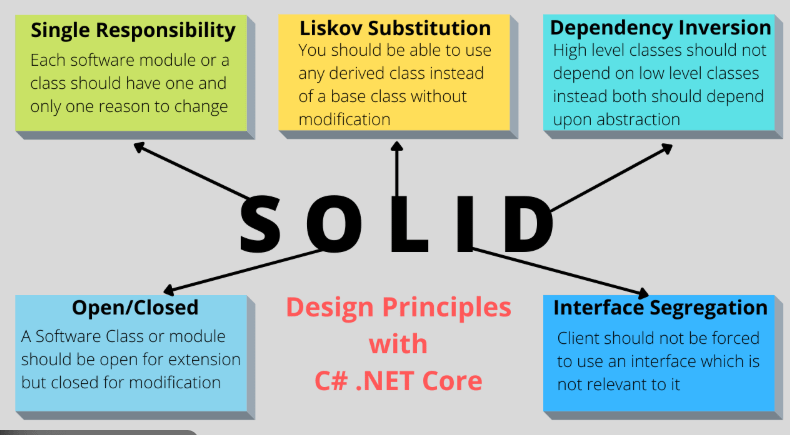
SOLID is an acronym that represents five object-oriented design principles:
- Single Responsibility Principle (SRP)
- Open/Closed Principle (OCP)
- Liskov Substitution Principle (LSP)
- Interface Segregation Principle (ISP)
- Dependency Inversion Principle (DIP)
Together, these principles guide developers on how to design classes, interfaces, and dependencies in a structured and flexible way.
Why SOLID Principles Are Important in C# and .NET
In real-world .NET projects, requirements change frequently. Without SOLID principles, even a small change can break multiple parts of the system. This leads to bugs, longer development time, and poor code quality.
SOLID principles solve these issues by:
- Reducing tight coupling between components
- Making code easier to extend and refactor
- Improving readability and maintainability
- Supporting long-term scalability
Therefore, applications become easier to manage as they grow.
Key Benefits of Using SOLID Principles
Applying SOLID principles in C# provides several practical benefits:
- Better Maintainability – Code changes are isolated and safer
- Improved Testability – Dependencies can be mocked easily
- Scalability – New features can be added without modifying existing code
- Cleaner Architecture – Responsibilities are clearly defined
- Team Productivity – Multiple developers can work without conflicts
For this reason, these benefits are especially valuable in large enterprise and microservices-based systems.
Real-World Use Cases of SOLID Principles
SOLID principles are widely used in:
- ASP.NET and ASP.NET Core applications
- Web APIs and Microservices
- Clean Architecture and Onion Architecture
- Domain-Driven Design (DDD)
- Large systems with changing business rules
Most modern frameworks and libraries are internally built using SOLID concepts.
Problems SOLID Principles Help Solve
In practice, SOLID principles help eliminate several common design problems, including the following:
- First, god classes that handle too many responsibilities
- Additionally, hard-coded dependencies that make code rigid
- As a result, repeated code when new features are added
- Consequently, fragile systems that break during frequent changes
By following SOLID principles, developers therefore create systems that remain flexible, scalable, and future-proof over time.
Conclusion
In summary, SOLID principles are not strict rules; instead, they are design guidelines that help developers write better object-oriented code.
As a result, mastering SOLID principles in C# improves both interview performance and real-world development skills.
Ultimately, these principles form the backbone of clean architecture and professional software design.
You may also read Abstract vs Interface in C# to understand another important concept.
Pingback: Single Responsibility Principle (SRP) in C# – Clean Code with Real Examples - Mika Dev Hub
Pingback: Open/Closed Principle (OCP) in C# – SOLID with Real Examples