
The Open/Closed Principle (OCP) in C# is the second and one of the most practical principles of the SOLID design principles. It states that software entities should be open for extension but closed for modification. In real-world .NET applications, OCP helps developers add new features without breaking existing, stable code.
Understanding OCP is critical for writing scalable applications and is also a frequently asked interview topic for mid to senior-level .NET developers.
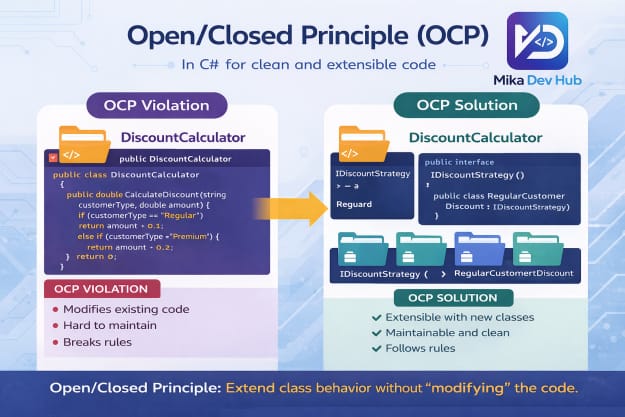
What Is the Open/Closed Principle?
The Open/Closed Principle means that you should be able to extend the behavior of a class without modifying its source code. Instead of changing existing logic, new functionality should be added using abstraction, inheritance, or composition.
In short:
Add new code, don’t change working code.
This approach reduces the risk of introducing bugs into already-tested functionality.
Why OCP Is Important in C# Applications
In enterprise .NET projects, business requirements change frequently. If existing classes are modified repeatedly:
- Bugs are introduced easily
- Regression testing increases
- Code becomes fragile and hard to maintain
By following OCP, developers protect stable code and make systems more flexible and future-ready.
OCP Violation Example in C#
❌ Problematic Code (OCP Violation)
public class DiscountCalculator
{
    public double CalculateDiscount(string customerType, double amount)
    {
        if (customerType == "Regular")
            return amount * 0.1;
        else if (customerType == "Premium")
            return amount * 0.2;

        return 0;
    }
}
What’s wrong here?
- Every new customer type requires modifying this class
- Risk of breaking existing logic
- Violates Open/Closed Principle
OCP-Compliant Solution in C#
✅ Refactored Code (Following OCP)
public interface IDiscountStrategy
{
    double Calculate(double amount);
}

public class RegularCustomerDiscount : IDiscountStrategy
{
    public double Calculate(double amount) => amount * 0.1;
}

public class PremiumCustomerDiscount : IDiscountStrategy
{
    public double Calculate(double amount) => amount * 0.2;
}

public class DiscountCalculator
{
    private readonly IDiscountStrategy _discountStrategy;

    public DiscountCalculator(IDiscountStrategy discountStrategy)
    {
        _discountStrategy = discountStrategy;
    }

    public double CalculateDiscount(double amount)
    {
        return _discountStrategy.Calculate(amount);
    }
}
Why this follows OCP
- New discount types can be added without modifying existing code
- Code is easier to test
- Logic is extensible and clean
- Works well with Dependency Injection
Benefits of Using Open/Closed Principle
Applying OCP in C# provides several advantages:
- Reduces regression bugs
- Improves maintainability
- Supports scalability
- Encourages clean architecture
- Enhances testability
As a result, applications become easier to evolve over time.
Real-World Use Cases of OCP
OCP is widely used in:
- ASP.NET Core middleware and filters
- Payment gateways and pricing rules
- Notification systems (Email, SMS, Push)
- Strategy-based business logic
- Plugin-based architectures
Most extensible frameworks internally rely on OCP.
Common Interview Questions on OCP
Q: What is Open/Closed Principle?
A: Software entities should be open for extension but closed for modification.
Q: How do you achieve OCP in C#?
A: By using abstraction, interfaces, inheritance, and dependency injection.
Q: Is OCP always required?
A: No, but developers strongly recommend OCP in areas where requirements change frequently.
Conclusion
The Open/Closed Principle is essential for building scalable and robust C# applications. Although it may require additional abstraction initially, it saves significant effort in the long run. By following OCP, developers add new features safely without impacting existing functionality.
In the next post, we will cover the Liskov Substitution Principle (LSP) with practical C# examples.
You may also read Solid Principles to understand concept.
Pingback: Single Responsibility Principle (SRP) in C# – Clean Code
Pingback: Liskov Substitution Principle in C# Explained with Examples
Pingback: Interface Segregation Principle (ISP) in C# – SOLID Principles Explained - Mika Dev Hub
Pingback: Design Patterns in .NET (C#) – Complete Guide & Best Practices