
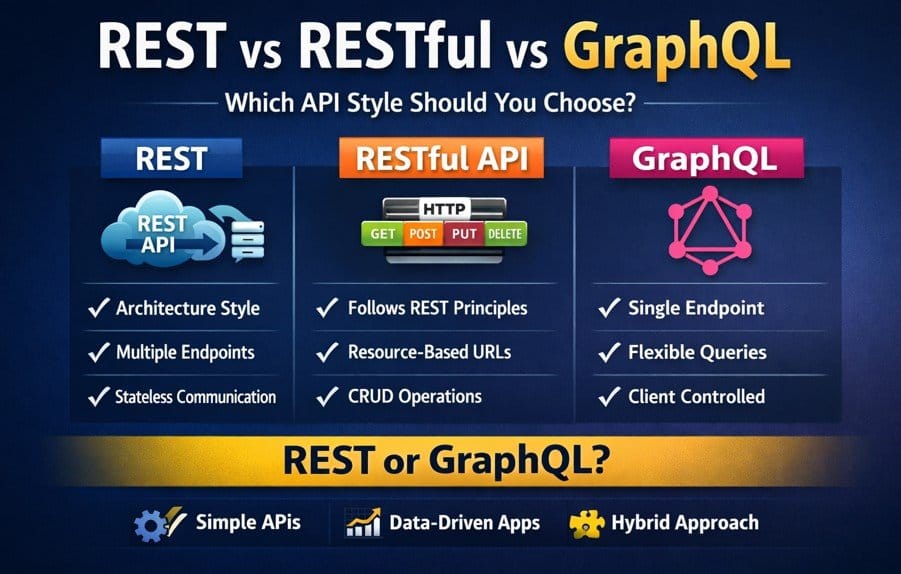
Which API Style Should You Choose and Why?
REST vs RESTful vs GraphQL, Choosing the right API style is no longer a minor technical decision. It directly affects performance, scalability, frontend flexibility, developer experience, and long-term maintenance.
Yet many developers and teams still struggle with questions like:
- What is the real difference between REST, RESTful APIs, and GraphQL?
- Is GraphQL better than REST?
- Which API style should I use in ASP.NET Core?
- What do interviewers expect me to explain clearly?
REST vs RESTful vs GraphQL, This in-depth guide answers all of these questions using real-world reasoning, clear comparisons, and practical decision rules—not buzzwords.
Understanding the Three API Styles
REST vs RESTful vs GraphQL, Before comparing them, you must clearly understand what each term actually means.
What Is REST?
REST (Representational State Transfer) is an architectural style, not a technology or framework.
REST defines how APIs should behave, not how they should be implemented.
Key ideas behind REST:
- Resources, not actions
- Stateless communication
- Standard HTTP semantics
- Uniform interfaces
REST itself does not produce an API. It only provides rules.
What Is a RESTful API?
A RESTful API is an API that correctly implements REST principles.
A RESTful API:
- Uses resource-based URLs
- Uses correct HTTP methods (GET, POST, PUT, DELETE)
- Returns proper HTTP status codes
- Remains stateless
👉 In practice, when developers say “REST API,” they usually mean RESTful API.
What Is GraphQL?
GraphQL is a query language for APIs, originally developed by Facebook.
Unlike RESTful APIs:
- GraphQL exposes a single endpoint
- The client decides what data it needs
- The server returns exactly that data—nothing more, nothing less
GraphQL shifts control from the server to the client.
Core Design Philosophy Differences
| Aspect | REST | RESTful | GraphQL |
|---|---|---|---|
| Nature | Architecture | Implementation | Query language |
| Endpoints | Conceptual | Multiple | Single |
| Data Control | Server | Server | Client |
| Flexibility | Medium | Medium | Very High |
| Learning Curve | Low | Low | Medium–High |
RESTful APIs Explained in Depth
How RESTful APIs Work
RESTful APIs expose resources via URLs.
Example:
GET    /api/users
GET    /api/users/5
POST   /api/users
PUT    /api/users/5
DELETE /api/users/5
Here:
- The URL represents the resource
- The HTTP method represents the action
Advantages of RESTful APIs
RESTful APIs remain the industry standard because they are:
✅ Simple and predictable
✅ Easy to cache
✅ Well supported by HTTP
✅ Ideal for microservices
✅ Easy to secure with JWT
Limitations of RESTful APIs
RESTful APIs struggle in data-heavy UI scenarios:
❌ Over-fetching data
❌ Under-fetching data
❌ Multiple round trips
❌ Tight frontend–backend coupling
Over-Fetching Example
GET /api/users/10
Response:
{
  "id": 10,
  "name": "John",
  "email": "john@test.com",
  "address": "...",
  "orders": [...],
  "payments": [...]
}
If the UI only needs name and email, REST still sends everything—unless you create custom endpoints.
GraphQL Explained in Depth
GraphQL was created to solve REST’s data-fetching problems.
How GraphQL Works
- Single endpoint (e.g.,
/graphql) - Client sends a query
- Server returns only requested fields
GraphQL Query Example
query {
  user(id: 10) {
    name
    email
  }
}
Response:
{
  "data": {
    "user": {
      "name": "John",
      "email": "john@test.com"
    }
  }
}
No extra data. No missing data.
Advantages of GraphQL
GraphQL shines when flexibility matters:
✅ Eliminates over-fetching
✅ Reduces API calls
✅ Strong typing via schema
✅ Perfect for frontend-driven apps
✅ Excellent for dashboards and mobile apps
Limitations of GraphQL
GraphQL is powerful—but not free:
❌ Complex server setup
❌ Harder HTTP caching
❌ Query performance risks
❌ Security concerns (deep queries)
❌ Overkill for simple CRUD APIs
RESTful vs GraphQL: Side-by-Side Comparison
| Feature | RESTful API | GraphQL |
|---|---|---|
| Endpoints | Multiple | Single |
| Data Fetching | Fixed | Client-defined |
| Over-fetching | Yes | No |
| Caching | Easy | Complex |
| Tooling | Mature | Modern |
| Best Use Case | CRUD APIs | Data-heavy UIs |
REST vs RESTful vs GraphQL – Key Differences
| Criteria | REST | RESTful | GraphQL |
|---|---|---|---|
| Definition | Architecture | Implementation | Query Language |
| HTTP Usage | Suggested | Enforced | Optional |
| Status Codes | Optional | Mandatory | Limited |
| Client Control | Low | Low | High |
| Scalability | Conceptual | High | High (with care) |
Which API Style Should You Choose?
This decision should be use-case driven, not trend driven.
Choose RESTful APIs When:
✅ You build CRUD-heavy systems
✅ You expose public or partner APIs
✅ You need strong HTTP caching
✅ You want simple, predictable APIs
✅ You build microservices
Examples:
- Banking systems
- Authentication services
- Payment APIs
- Enterprise backends
Choose GraphQL When:
✅ You build frontend-heavy applications
✅ You support multiple clients (web, mobile)
✅ You need flexible data contracts
✅ You want fewer API calls
✅ You build dashboards or social apps
Examples:
- Analytics dashboards
- Social platforms
- E-commerce frontends
- Mobile-first apps
Can RESTful APIs and GraphQL Coexist?
Yes—and many modern architectures do this.
Hybrid Architecture Example
- RESTful APIs → Auth, payments, admin, core services
- GraphQL → UI data aggregation layer
This approach balances simplicity, performance, and flexibility.
REST & GraphQL in ASP.NET Core
ASP.NET Core supports both styles effectively.
RESTful APIs
- Controllers
- Routing
- Filters
- Middleware
GraphQL in ASP.NET Core
Works via libraries like:
- Hot Chocolate
- GraphQL.NET
GraphQL requires:
- Schema design
- Resolvers
- Query validation
- Security controls
Interview Perspective (Very Important)
Common Interview Question
“Which is better: REST or GraphQL?”
❌ Wrong answer:
GraphQL is always better.
✅ Correct answer:
RESTful APIs are ideal for simple, cacheable, CRUD-based systems, while GraphQL works best for data-heavy, frontend-driven applications requiring flexibility.
REST vs RESTful vs GraphQL – Quick Decision Table
| Scenario | Best Choice |
|---|---|
| Simple CRUD | RESTful |
| Public API | RESTful |
| Mobile App | GraphQL |
| Dashboard | GraphQL |
| Microservices | RESTful |
| Complex UI | GraphQL |
| Hybrid System | REST + GraphQL |
Frequently Asked Questions (FAQ)
Is REST the same as RESTful?
No. REST is an architectural style, while RESTful APIs are implementations that strictly follow REST principles.
Is GraphQL better than REST?
No. GraphQL excels in data-heavy, UI-driven applications. RESTful APIs work better for simple, cacheable systems.
Can REST and GraphQL be used together?
Yes. Many modern systems use RESTful APIs for core services and GraphQL for frontend data aggregation.
Is GraphQL faster than REST?
Not always. GraphQL reduces network calls but can hurt performance if queries are poorly designed.
Which API style is best for ASP.NET Core?
RESTful APIs are the default and best choice for most ASP.NET Core backends. GraphQL fits well when flexibility is required.
Final Thoughts
There is no universally best API style.
- REST defines the rules
- RESTful applies them correctly
- GraphQL adds flexibility where REST struggles
Strong engineers choose based on context, not hype.
If you understand these differences clearly, you stand out in:
- System design discussions
- Architecture decisions
- Senior-level interviews
Pingback: ASP.NET Core API Performance: Proven Optimization Techniques
Pingback: Caching in ASP.NET Core (In-Memory vs Distributed vs Redis) - Mika Dev Hub
Pingback: SQL Server Performance Tuning: Complete Guide with Real Examples