
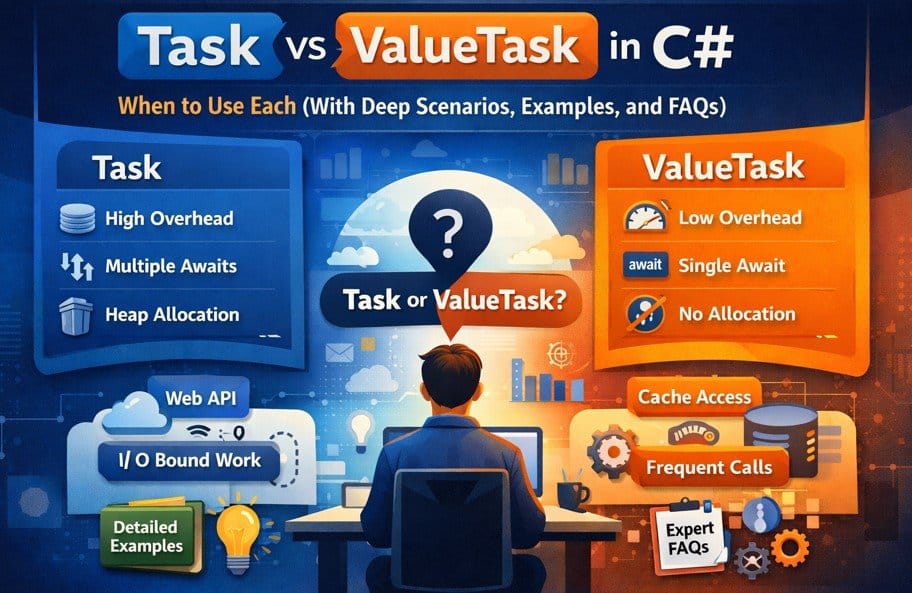
1. Introduction: Why Task vs ValueTask Is Not a Trivial Topic
Asynchronous programming is no longer optional in C#. Any modern application—Web APIs, cloud services, background workers, or desktop apps—relies heavily on async and await to remain responsive and scalable.
Most developers use Task without thinking twice. That is a good thing. Task was designed to be safe, expressive, and easy to reason about. However, as applications grow and performance becomes critical, you may encounter ValueTask, especially in framework code or performance-sensitive libraries.
This often raises confusion:
- Is
Taskinefficient? - Should we replace
TaskwithValueTaskeverywhere? - Why does Microsoft warn against casual use of
ValueTask?
This article answers these questions in depth, with clear reasoning, real-world scenarios, and practical examples, so you can make the right decision—not just pass interviews, but write maintainable production code.
2. Understanding Task in C#: The Foundation of Async Code
Task represents an asynchronous operation that may complete in the future. It acts as a promise that the operation will eventually finish, either successfully, with an exception, or via cancellation.
Why Task Became the Default
- It integrates naturally with
async/await - It supports exception propagation
- It allows multiple awaits safely
- It works consistently across all application layers
Simple Example
public async Task<int> GetOrderCountAsync()
{
    await Task.Delay(500);
    return 25;
}
This method:
- Always executes asynchronously
- Always allocates a
Task - Keeps behavior predictable for callers
Key Insight
Task optimizes developer productivity and correctness, not micro-performance. For most applications, this trade-off is ideal.
3. The Cost of Task Allocation (Why Optimization Entered the Picture)
Each Task is a reference type allocated on the heap. In everyday business applications, this allocation cost is negligible. The garbage collector handles it efficiently.
However, problems appear in high-throughput systems, where:
- Methods run thousands or millions of times per second
- Results are often already available
- Allocation becomes pure overhead
Example Scenario
Imagine a high-frequency cache lookup method. If the value already exists in memory, creating a new Task just to return it wastes resources.
This exact inefficiency led to the introduction of ValueTask.
4. What Is ValueTask and Why Does It Exist?
ValueTask is a struct-based asynchronous return type introduced to reduce unnecessary heap allocations when an async method frequently completes synchronously.
Unlike Task, ValueTask can represent:
- A completed result (no allocation)
- A wrapped
Task(fallback to async)
Example with Explanation
public ValueTask<int> GetCachedItemAsync(int id)
{
    if (_cache.TryGetValue(id, out int value))
        return new ValueTask<int>(value);

    return new ValueTask<int>(LoadFromDbAsync(id));
}
Here:
- Cache hit → synchronous completion, no heap allocation
- Cache miss → normal async execution
Key Insight
ValueTask optimizes execution paths, not overall application design.
5. Core Design Differences: Task vs ValueTask (Expanded)
| Aspect | Task | ValueTask |
|---|---|---|
| Type | Reference type | Value type (struct) |
| Allocation | Always allocates | Can avoid allocation |
| Complexity | Low | High |
| Safety | Very safe | Requires strict usage |
| Reusability | Await multiple times | Single consumption |
| Default choice | Yes | No |
Important Clarification
ValueTask is not a better Task.
It is a specialized performance tool with trade-offs.
6. Real-World Scenarios (Deeply Explained)
Scenario 1: ASP.NET Core Web API (Use Task)
public async Task<IActionResult> GetProducts()
{
    var products = await _service.GetProductsAsync();
    return Ok(products);
}
Why Task is correct:
- Database and HTTP calls are always async
- Network latency dominates execution time
- Allocation cost is irrelevant
Deeper Reasoning:
Web APIs favor clarity, logging, retries, and observability. Task supports all of these safely.
Scenario 2: In-Memory Cache Access (ValueTask Is Justified)
public ValueTask<User> GetUserAsync(int id)
{
    if (_cache.TryGetValue(id, out var user))
        return new ValueTask<User>(user);

    return new ValueTask<User>(_repo.GetUserAsync(id));
}
Why ValueTask works well here:
- Cache hits are common
- Method is called frequently
- Allocation avoidance compounds over time
Key Point:
This is one of the few scenarios where ValueTask clearly provides benefit.
Scenario 3: Business Logic Layer (Avoid ValueTask)
public async Task<bool> ProcessPaymentAsync(Payment payment)
{
    Validate(payment);
    await _gateway.PayAsync(payment);
    return true;
}
Why Task is better:
- Business rules dominate execution time
- Code readability matters more than micro-optimizations
- Future maintainers expect
Task
Using ValueTask here increases risk without reward.
Scenario 4: Library or Framework APIs
Framework authors sometimes expose APIs like:
public ValueTask<bool> WaitAsync();
Why frameworks use ValueTask:
- Code executes at massive scale
- Every allocation matters
- Callers are advanced developers
⚠️ This requires strict documentation and discipline.
7. Critical Rules of ValueTask (With Explanation)
Rule 1: Never Await a ValueTask More Than Once
var vt = GetValueAsync();
await vt;
await vt; // ❌ Bug
Once consumed, the underlying operation may not exist anymore.
Rule 2: Never Store ValueTask
private ValueTask<int> _cachedTask; // ❌ Dangerous
ValueTask may wrap transient state that becomes invalid later.
Rule 3: Convert to Task When Needed
Task<int> task = valueTask.AsTask();
This sacrifices performance for safety—often a good trade-off.
8. Why ValueTask Is Easy to Misuse
Task behaves predictably. You can:
- Await it multiple times
- Pass it across layers
- Store it safely
ValueTask does not offer these guarantees. It requires:
- Correct consumption
- Lifetime awareness
- Performance measurement
This is why most application developers should default to Task.
9. Performance Reality (No Myths)
- ValueTask is faster only when synchronous completion dominates
- Async I/O scenarios see little to no benefit
- Misuse can reduce performance and increase bugs
Golden Rule:
Never optimize before measuring.
10. Interview Question: Why Not Always Use ValueTask?
Strong, Senior-Level Answer:
ValueTask exists to reduce allocations in high-frequency paths where synchronous completion is common. However, it adds complexity and usage constraints. For most application code, Task is safer, clearer, and sufficient.
This answer demonstrates judgment, not memorization.
11. Decision Guide (Expanded)
| Scenario | Recommended | Reason |
|---|---|---|
| Controllers | Task | I/O-bound |
| Business services | Task | Maintainability |
| Database access | Task | Always async |
| Cache-heavy methods | ValueTask | Sync completion |
| Libraries | ValueTask | Scale |
| Unsure | Task | Safety |
12. Common Mistakes Developers Make
- Using ValueTask everywhere to look advanced
- Ignoring lifetime rules
- Copying framework code blindly
- Optimizing too early
- Trading clarity for micro-performance
13. Best Practices Summary (Reinforced)
- Start with Task
- Measure before optimizing
- Use ValueTask only when justified
- Document intent clearly
- Prefer maintainability over cleverness
14. Final Verdict
Task solves asynchronous programming for almost every real-world scenario.ValueTask solves a very narrow performance problem.
Senior developers do not chase complexity—they choose clarity first, optimization second.
15. Frequently Asked Questions (FAQ) – In-Depth Explanations
FAQ 1: Is ValueTask always faster than Task?
Short answer: No.
Detailed explanation:ValueTask is faster only in very specific scenarios—when a method completes synchronously most of the time. In such cases, it avoids heap allocation and reduces garbage collection pressure.
However, if the operation is:
- I/O-bound (database, HTTP, file system)
- Almost always asynchronous
- Rarely completed synchronously
then ValueTask provides no measurable performance benefit. In fact, it may introduce extra overhead because the runtime has to handle more complex execution paths.
Key takeaway:
ValueTaskimproves performance only when synchronous completion dominates execution.
FAQ 2: Should I replace all Task returns with ValueTask for performance?
Short answer: Absolutely not.
Detailed explanation:
Replacing Task with ValueTask everywhere is a common mistake made by developers who optimize prematurely. Task is designed to be safe, readable, and flexible. It allows:
- Multiple awaits
- Easy passing across layers
- Storage and reuse
ValueTask removes these guarantees to gain performance in narrow scenarios. Using it everywhere:
- Increases code complexity
- Increases bug risk
- Confuses future maintainers
Key takeaway:
Taskis the default choice.ValueTaskis a targeted optimization tool.
FAQ 3: Why does Microsoft warn against casual use of ValueTask?
Short answer: Because it is easy to misuse.
Detailed explanation:
Microsoft documentation explicitly warns developers because ValueTask:
- Must not be awaited multiple times
- Must not be stored
- Requires careful lifetime management
Breaking these rules does not always fail immediately. Instead, it may cause subtle, hard-to-reproduce bugs in production—especially under load.
Framework authors understand these risks and design APIs carefully. Application developers often do not need this complexity.
Key takeaway:
ValueTasktrades safety for performance. That trade-off must be intentional.
FAQ 4: Can I safely await a ValueTask multiple times?
Short answer: No.
Detailed explanation:
Unlike Task, ValueTask may wrap a one-time operation or a reusable resource that becomes invalid after the first await. Awaiting it more than once can:
- Throw runtime exceptions
- Produce incorrect results
- Lead to undefined behavior
Example (❌ incorrect):
var vt = GetDataAsync();
await vt;
await vt; // Bug
Correct approach:
If you need to await multiple times, convert it:
Task task = vt.AsTask();
await task;
await task;
Key takeaway:
ValueTaskis single-use by design.
FAQ 5: Can I store a ValueTask in a field or variable for later use?
Short answer: No, and this is dangerous.
Detailed explanation:ValueTask may internally reference:
- Temporary buffers
- Pooled objects
- Stack-based state
Storing it breaks lifetime assumptions and can corrupt execution. This is one of the most dangerous mistakes because it often passes tests and fails later under real load.
Incorrect example:
private ValueTask<int> _pendingTask; // ❌
Key takeaway:
Never store
ValueTask. Consume it immediately.
FAQ 6: When is ValueTask actually the right choice?
Short answer: In high-frequency, low-latency methods that often complete synchronously.
Detailed explanation:
Correct use cases include:
- In-memory cache lookups
- Object pooling APIs
- Parsing pipelines
- Framework or library internals
In these cases:
- Methods are called extremely often
- Allocation savings accumulate
- Performance improvements are measurable
Key takeaway:
Use
ValueTaskonly when synchronous completion is common and proven.
FAQ 7: Should I use ValueTask in ASP.NET Core controllers?
Short answer: No, in almost all cases.
Detailed explanation:
ASP.NET Core controllers typically:
- Perform database calls
- Call external services
- Execute network I/O
These operations are inherently asynchronous. Allocation cost of Task is insignificant compared to I/O latency.
Using ValueTask in controllers:
- Adds complexity
- Provides no benefit
- Confuses team members
Key takeaway:
Controllers should return
Task, notValueTask.
FAQ 8: Does ValueTask reduce garbage collection pressure?
Short answer: Yes, but only in specific scenarios.
Detailed explanation:
When synchronous completion happens frequently, ValueTask avoids heap allocation entirely, reducing:
- GC frequency
- Memory churn
- CPU overhead
However, if async execution dominates, ValueTask still wraps a Task, and GC behavior remains similar.
Key takeaway:
GC benefits exist only when allocation is avoided consistently.
FAQ 9: How do I decide between Task and ValueTask in real projects?
Decision framework:
- Start with
Task - Measure performance
- Identify hot paths
- Confirm synchronous completion dominance
- Switch to
ValueTaskonly if justified
If you skip step 2 (measurement), you are guessing.
Key takeaway:
Optimization without measurement is speculation.
FAQ 10: Is ValueTask important for senior-level interviews?
Short answer: Yes, but not for syntax.
Detailed explanation:
Interviewers ask about ValueTask to evaluate:
- Performance awareness
- Judgment
- Understanding of trade-offs
They are not looking for:
- Blind enthusiasm
- Over-optimization
They want to hear:
“I default to Task and use ValueTask only when performance data proves it is necessary.”
Key takeaway:
Seniors know when not to optimize.
FAQ 11: Can I return ValueTask from public APIs?
Short answer: Only if you fully understand the consequences.
Detailed explanation:
Public APIs lock consumers into your design choices. Returning ValueTask:
- Forces consumers to understand its rules
- Limits flexibility
- Increases misuse risk
Most public APIs should return Task unless they are part of a performance-critical framework.
Key takeaway:
Public APIs should favor safety over micro-performance.
FAQ 12: What is the biggest mistake developers make with ValueTask?
Answer: Using it everywhere to look “advanced.”
Why this is dangerous:
- Code becomes harder to reason about
- Bugs appear under load
- Team members misuse it
Correct mindset:
Advanced developers use simple tools correctly, not complex tools unnecessarily.
Final FAQ Summary
Taskis the correct defaultValueTaskis a specialized optimization- Use
ValueTaskonly when synchronous completion dominates - Never await or store
ValueTaskincorrectly - Measure performance before optimizing
Related Articles
- How to Fix 401 Unauthorized in ASP.NET Core JWT
- How to Fix CORS Error in ASP.NET Core API
- ASP.NET Core Swagger Not Showing – Complete Solution Guide
- Entity Framework Migration Failed – Common Reasons and Fixes (Complete Guide)