
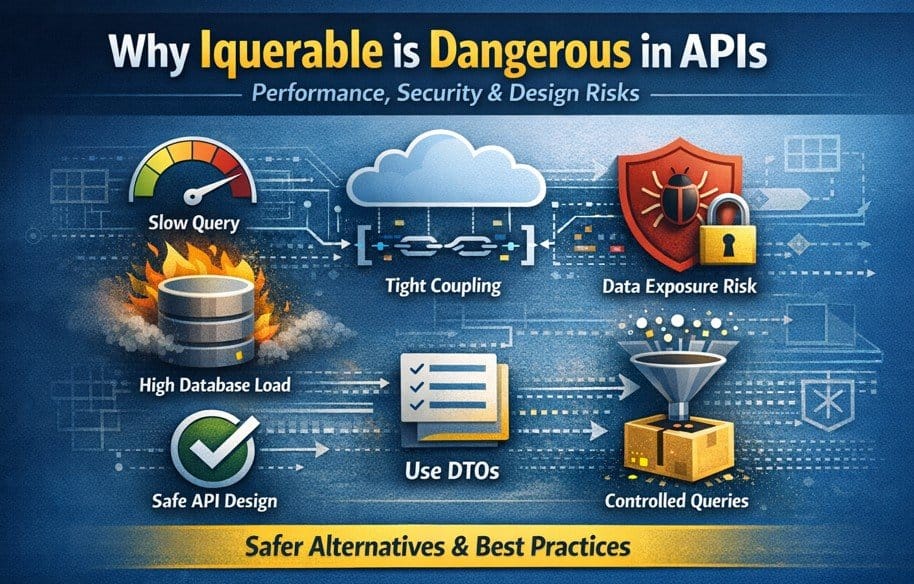
Introduction
At first glance, returning IQueryable from an API looks elegant and powerful. It promises flexibility, composability, and reduced code. Many developers assume this approach follows best practices—especially when using Entity Framework.
In reality, exposing IQueryable from APIs is one of the most dangerous design mistakes in modern .NET applications.
This mistake can silently introduce:
- Severe performance problems
- Unpredictable database queries
- Security and data exposure risks
- Tight coupling between API and database
- Production issues that are extremely hard to debug
This article explains why IQueryable is dangerous in APIs, how it breaks architectural boundaries, and what you should use instead in real-world systems.
What Is IQueryable in .NET?
IQueryable<T> represents a query that has not been executed yet. Instead of holding data, it holds an expression tree that a query provider (like Entity Framework) later translates into SQL.
IQueryable<User> users = _dbContext.Users;
At this point:
- No SQL has executed
- No data has been loaded
- The query is still mutable
This deferred behavior is powerful inside application boundaries—but toxic across API boundaries.
Deferred Execution: The Core Reason IQueryable Is Risky
IQueryable uses deferred execution, meaning the query runs only when it is enumerated.
var query = _dbContext.Users.Where(u => u.IsActive);
// SQL not executed

var list = query.ToList();
// SQL executes here
In APIs, this creates a fundamental problem:
The API no longer controls when, how, or with what conditions the query executes.
Once control is lost, performance, security, and stability are all at risk.
Why Returning IQueryable from APIs Is a Bad Idea
Loss of query execution control
When an API returns IQueryable, the query can still be modified outside the API layer. Consumers can apply additional filters, sorting, pagination, or projections.
[HttpGet]
public IQueryable<User> GetUsers()
{
    return _dbContext.Users;
}
This code exposes:
- Database structure
- Query composition
- Execution timing
The API becomes a pass-through to the database, not a controlled contract.
Performance becomes unpredictable
With IQueryable, SQL is generated at runtime based on how the consumer modifies the query. This leads to:
- Unexpected joins
- Inefficient WHERE clauses
- Missing indexes
- Large result sets
- Full table scans
These problems often:
- Do not appear in development
- Only surface under production load
- Are extremely difficult to trace back to the root cause
A single poorly constructed request can slow down the entire system.
APIs become vulnerable to query abuse
Even if SQL injection is not directly possible, IQueryable enables query abuse.
Consumers can:
- Request massive datasets
- Apply complex ordering
- Chain expensive filters
- Trigger heavy database computation
This can cause:
- High CPU usage on the database
- Request timeouts
- Denial-of-service-like behavior
APIs must defend the database, not expose it.
Security and data exposure risks
Returning IQueryable often means returning entity models directly.
This can unintentionally expose:
- Internal columns
- Audit fields
- Flags and status values
- Navigation properties
return _dbContext.Users;
Even if today’s UI does not use those fields, APIs should never assume trusted consumers. Once exposed, data cannot be taken back.
Tight coupling between API and database
IQueryable leaks implementation details:
- Entity Framework usage
- Table structure
- Navigation relationships
- Database design choices
This tight coupling means:
- Database refactoring becomes risky
- Entity changes can break clients
- API evolution slows down
A well-designed API exposes contracts, not database queries.
Violation of layered architecture
In a clean architecture:
- Controllers handle HTTP concerns
- Services handle business rules
- Repositories handle data access
Returning IQueryable breaks this separation:
- Query logic leaks outside repositories
- Business rules scatter across layers
- Testing becomes harder and less reliable
This directly violates:
- Separation of Concerns
- Single Responsibility Principle
Real Production Failure Pattern
A common real-world scenario looks like this:
- API returns
IQueryable - Frontend adds dynamic filters and sorting
- SQL grows complex over time
- Database CPU spikes
- Requests slow down
- Entire system becomes unstable
The root cause often traces back to one design decision:
Exposing
IQueryablefrom an API.
Why IQueryable Is Especially Dangerous in Microservices
In microservice architectures:
- Each service owns its data
- Boundaries must be strict
- Contracts must be stable
Exposing IQueryable across services:
- Violates service autonomy
- Creates tight coupling
- Breaks independent deployment
Microservices demand strong boundaries, and IQueryable weakens them.
Security Beyond Data Exposure
Even when sensitive fields are hidden, IQueryable can still:
- Reveal database performance characteristics
- Expose relationship depth
- Allow inference of data size and structure
Attackers can use this information to:
- Craft expensive queries
- Stress specific tables
- Target weak points in schema design
Security is not just about hiding fields—it’s about controlling behavior.
Why IQueryable Looks Attractive (But Isn’t)
Developers often choose IQueryable because:
- It feels flexible
- It reduces code duplication
- It enables dynamic querying
Unfortunately, flexibility without boundaries is dangerous in distributed systems. What looks convenient today often becomes tomorrow’s outage.
IQueryable vs API Contract Design
A good API contract is:
- Explicit
- Stable
- Predictable
- Independent of implementation
Returning IQueryable violates all of these principles by:
- Exposing internals
- Allowing uncontrolled behavior
- Shifting responsibility to the consumer
APIs should answer questions, not provide tools to query the database.
How IQueryable Breaks API Versioning
APIs evolve over time. Fields change, entities get refactored, and business rules shift. When an API returns IQueryable, it silently locks consumers to the current database structure.
Because consumers can build queries dynamically:
- Removing a column can break clients
- Renaming a property can change generated SQL
- Changing relationships can alter query behavior
This makes API versioning extremely risky. Even a minor internal refactor can cause unexpected failures on the client side.
Key insight:
APIs should evolve independently. Exposing IQueryable makes that almost impossible.
IQueryable and Over-Fetching Problems
When you return IQueryable, consumers often fetch more data than needed because they control projection.
This leads to:
- Large payloads
- Increased memory usage
- Slower response times
- Higher network costs
Even when pagination is applied, the underlying query may still:
- Load unnecessary joins
- Pull extra columns
- Perform inefficient SQL operations
Using DTOs with explicit projections prevents over-fetching and keeps responses lean.
IQueryable Makes Caching Ineffective
Caching works best when responses are:
- Predictable
- Repeatable
- Deterministic
IQueryable breaks all three.
Because queries can change per request:
- Cache keys become complex
- Cache hit rates drop
- Response consistency disappears
This makes:
- Response caching
- Output caching
- Distributed caching
far less effective.
Key takeaway:
Controlled queries enable effective caching. IQueryable destroys cache predictability.
Logging and Monitoring Become Much Harder
When APIs execute queries internally, you can:
- Log executed SQL
- Track slow queries
- Monitor performance hotspots
- Correlate API calls with database load
With IQueryable:
- SQL executes late
- Execution context becomes unclear
- Logs lose meaningful correlation
This makes production debugging:
- Slower
- More expensive
- More error-prone
In high-traffic systems, observability is critical—and IQueryable works against it.
What to Use Instead of IQueryable in APIs
Return materialized collections
Execute queries inside the API and return concrete results.
public async Task<List<UserDto>> GetUsersAsync()
{
    return await _dbContext.Users
        .Where(u => u.IsActive)
        .Select(u => new UserDto
        {
            Id = u.Id,
            Name = u.Name
        })
        .ToListAsync();
}
This approach:
- Executes SQL in a controlled place
- Prevents query manipulation
- Improves security and predictability
Use explicit query parameters
Let the API define what is allowed.
public async Task<List<UserDto>> GetUsersAsync(
    int page,
    int pageSize,
    string sortBy)
The API controls:
- Filtering
- Sorting
- Pagination
- Validation
This creates a stable, predictable contract.
Use DTOs instead of entities
DTOs protect your internal models and:
- Prevent over-fetching
- Improve security
- Allow independent evolution of API and database
Use specifications or query objects
Encapsulate query logic inside the service layer. This keeps flexibility inside the application while keeping the API boundary safe.
When IQueryable Is Actually Safe
IQueryable is safe:
- Inside repositories
- Inside service layers
- Within the same application boundary
IQueryable is unsafe:
- In API responses
- In public contracts
- Across service boundaries
The rule is simple:
Never expose deferred execution outside your control.
Interview Perspective: How Seniors Answer This
Question: Why is IQueryable dangerous in APIs?
Strong answer:
IQueryable uses deferred execution and allows consumers to control query composition. This leads to unpredictable SQL generation, performance issues, security risks, and tight coupling. APIs should always control query execution and return materialized results.
This answer demonstrates judgment, not just knowledge.
How Senior Developers Think About IQueryable
Senior developers ask:
- Who controls execution?
- Who owns performance?
- Who is responsible when things fail?
If the answer is “the client,” the design is already wrong.
Good APIs:
- Protect the database
- Enforce rules
- Own performance characteristics
Frequently Asked Questions
Is IQueryable bad in general?
No. IQueryable is extremely powerful inside application boundaries. The danger comes from exposing it across APIs.
Can IQueryable cause performance issues?
Yes. Because SQL is generated at runtime based on consumer behavior, performance problems often appear only in production.
Does returning IQueryable cause SQL injection?
Not directly, but it allows query abuse and expensive execution paths that can overwhelm the database.
Why do some tutorials return IQueryable?
Many tutorials optimize for simplicity, not production safety. Real-world APIs require stronger boundaries.
What is the safest alternative to IQueryable?
Return DTOs with controlled filtering, sorting, and pagination executed inside the API.
Final Verdict
IQueryable is a powerful tool—but only when used in the right place.
Exposing it from APIs:
- Breaks encapsulation
- Destroys predictability
- Creates security and performance risks
Senior developers understand one key rule:
Expose data, not queries.
Pingback: REST vs RESTful vs GraphQL – Which Style Should You Choose?
Pingback: SQL Server Deadlock Detection: How to Detect and Fix Deadlocks